
Gutter Repair in the USA
Gutters direct water away from the roof edge and foundation. When a run loses slope or a joint opens, water spills over the back and soaks the fascia or enters the soffit. Our crews trace the path from the highest point of the run to the downspout to locate every break in flow.
Common causes include debris buildup, nail pops from thermal movement, and ice weight that bends the front lip. Technicians measure the existing pitch with a level and string line before any work begins so the corrected run will carry water at the proper rate. Water entry points get marked during gutter repair calls by Shawnee County Roofing Services ahead of the homepage roof repair guide.
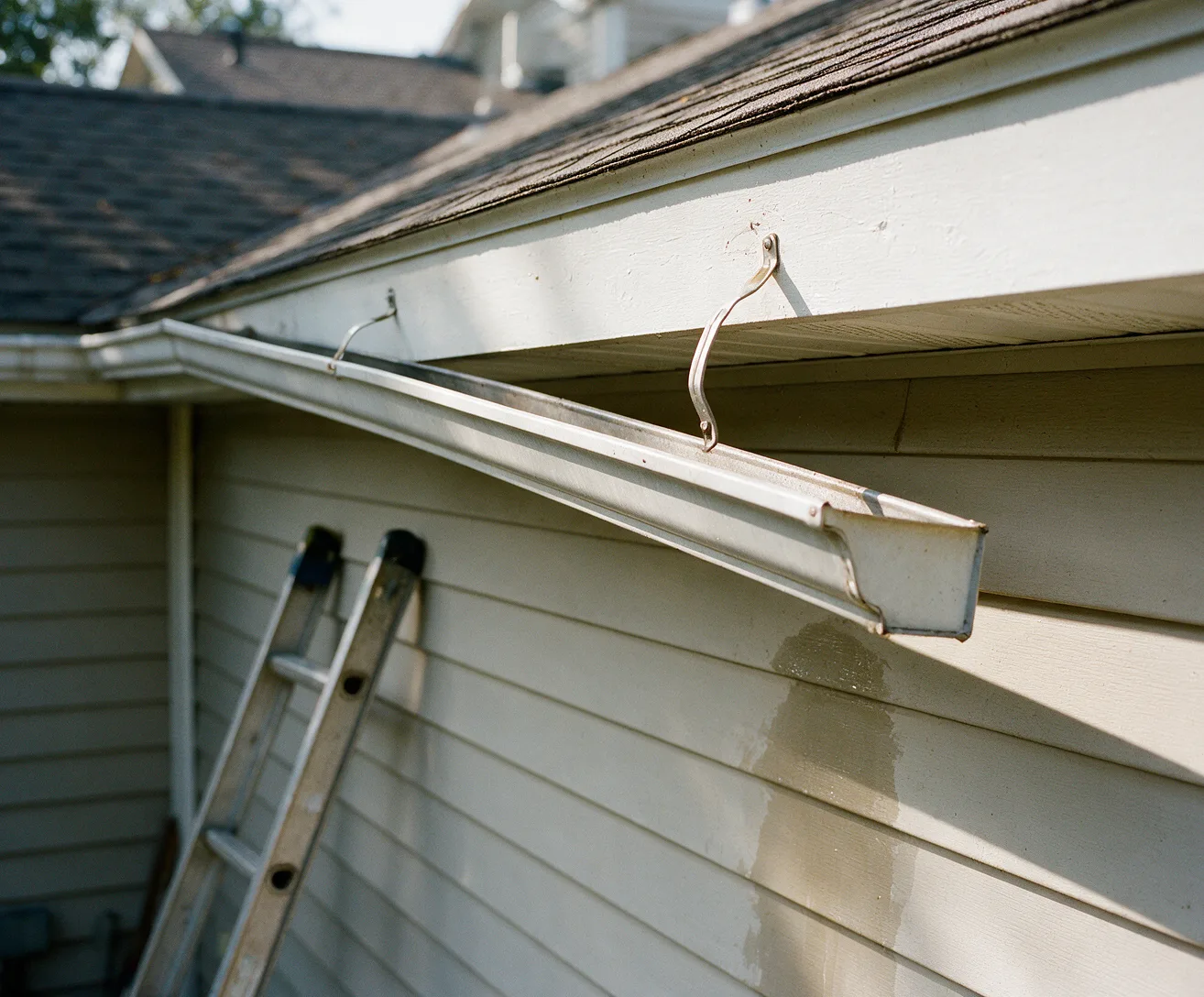
Visible Indicators of Gutter Problems
- Water stains appear along the fascia board after rain.
- Overflow occurs at seams during moderate rainfall.
- Downspout elbows pull away from the wall brackets.
- Sags develop between hanger locations on long runs.
- Rust flakes collect on the ground beneath metal sections.
What Technicians Check on Site
Our technicians start at the highest corner and walk the full length. They check hanger spacing, usually every 24 to 36 inches, and test each fastener by hand for movement. Joints receive close attention because mastic often cracks after several freeze-thaw cycles.
Slope is confirmed with a four-foot level and a string line pulled tight from end to end. A proper run drops one quarter inch per foot toward the outlet. Any reversal or flat spot is marked for correction before repairs continue.
Outlets and elbows are inspected for dents or partial blockages that reduce capacity. Technicians also look for corrosion on the inside bottom of the gutter where water sits longest.
Repair and Replacement Choices
Small holes receive butyl tape backed by a metal patch riveted in place. Loose seams are cleaned and resealed with a compatible gutter sealant rather than generic caulk that fails under expansion. When a section has multiple failures, that portion is cut out and replaced with a new piece that matches the profile.
Full runs can be rebuilt using sectional pieces or continuous roll-formed material. New hangers are installed at correct spacing and angled to restore pitch. Downspout connections are upgraded to larger elbows if the original size restricts flow during heavy rain.
Technicians carry both five-inch and six-inch profiles so the new gutter matches the roof's water volume without changing the visual line along the eave.
Materials and Hardware Used
Aluminum remains the most common choice because it resists rust and forms easily around corners. Heavier steel or copper is selected when the homeowner wants longer service life or a specific appearance. All new sections receive matching finish to reduce visible contrast after installation.
Hangers are either hidden or face-mounted depending on the fascia condition. Stainless rivets and external sealants rated for exterior metal joints prevent future leaks at every connection point.
Leaf strainers or mesh guards can be added at the same time if debris load is high. These sit inside the gutter and do not alter the outer profile or water flow capacity.
First Steps for the Homeowner
Clear loose leaves and sticks from the open gutter using a plastic scoop while standing safely on the ground. Avoid reaching from a ladder if the roof edge is high or the ground is uneven. Note any sections that still hold water after the debris is removed.
Observe the downspout discharge during the next rain to confirm water leaves the property rather than pooling near the foundation. Photograph any visible sags or stains so the crew can locate them quickly on arrival.
Gutter Repair questions
How do technicians restore proper slope?
They remove existing hangers, pull a string line from the high end to the outlet, and reinstall hangers at the correct drop of one quarter inch per foot. New fasteners go into solid wood rather than damaged fascia.
Can a single joint be fixed without replacing the whole run?
Yes. The joint is cleaned of old sealant, any gaps are closed with rivets, and fresh gutter-grade sealant is applied inside and out. The repair is tested with water before the crew leaves.
What profile sizes are available for replacement?
Five-inch K-style handles most residential roofs. Six-inch K-style or half-round is used on larger surfaces or where heavy rainfall is common. The new material matches the existing color and shape.
Do crews work on both metal and vinyl gutters?
They repair aluminum, steel, and copper. Vinyl sections are usually replaced because the material becomes brittle and does not accept sealant well after age. Matching vinyl is installed using the same hanger layout.
Request Gutter Repair
Contact Shawnee County Roofing Services to schedule an inspection of your gutter system.